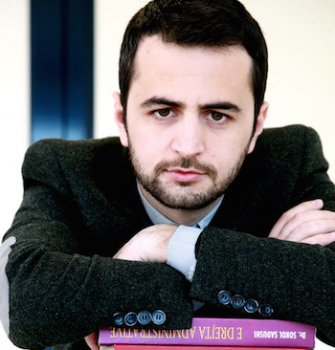






Endrit Shabani*
I must have been ten when my family was in a difficult economic situation, and I had to work a little
bit. One day, as I was carrying some heavy stuff, a posh father and his son were passing by. As they saw me in that situation, the father addressed his son with more or less these words: ‘Listen to what I’m saying. If you don’t study, you’ll end up like him’. I felt awful that the father was using my difficult situation to scare his own son. Besides, it was inaccurate, because he was assuming that I was poor because of not studying, which was not the case. I was poor because I was unfortunate and no matter how much I (and my parents) tried, some things could not change that easily. However, not understanding the context did not stop him from jumping to conclusions. Neither did he consider how his words would make me feel.

This story is running through my mind recently since the Remain campaigners started getting at Albania to attack the other camp. It all began with the Justice Secretary, Michael Gove, who brought Albania’s relations with the EU as an example of the possible agreement that the UK might have in the event of leaving the EU. It went on and on with a costly campaign portraying Albania as ‘the other’, the end of the world, the travel back in middle ages, or the end of civilisation for the Britons. Comments vary from some unpleasant ones, such as how poor Albania is, to remarks on the level of education and skills of Albanians, such as ‘poorly educated and unskilled Eastern European workers’. The latter stands very far on the spectre of comparing with just another country and are offensive, if not xenophobic.
As an Albanian, I do not know how should I feel about all of this, provided that I find it unethical to make fun of another country, just because it is poorer than yours. It is even more, when one focuses solely on a particular aspect of Albania, takes some pictures of a poor neighbourhood and claims to grasp how Albanian society is and how it is to live in Albania. I believe that every Briton who does not like their country being mocked by others on particular political, economic or social aspects, can understand how it feels for Albanians in days like these when their home country is portrayed as a scary dream.
It is concerning that this is not the first time, not even the first for this year, that British politicians have mocked Albania and made fun of those who might turn the UK into a second Albania. It is even more when such attacks come from a camp that allegedly is in support of a large European family. You would expect that those who are in favour of a UK within the EU would embrace values of a European brotherhood. However, although Albania belongs to the continental Europe, one gets comments that encourage and reinforce stereotypes of the Eastern European countries who are aspiring to join the EU. And all of this is done in the name of a stronger EU(?!). I doubt that this kind of discourse is going to make it any easier for countries like Albania (which currently holds a candidate status) to join the EU, especially if we consider the role that national parliaments play in admitting any new European member.
We have to admit though that Albania is small, and it is such due to the role played by the big powers in the London Treaty, which decided its current borders. Yes, Albania is poor, and this is also due to the decision to leave it under the Stalin’s influence while he and Churchill divided Europe. Yes, many people are now leaving the country, and this is also due to the reforms undertaken by a government whose top consultant is the Former British PM. But is Albania small and poor and faces high rates of emigration because it refused to join the EU? Hell no. Furthermore, it is clear that whatever decision Britons take on 23rd of June, there is not a single chance that the UK will end up being a country of nearly three million inhabitants with a GDP of less than 10 billion GBP. Then why would the Remain campaigners involve Albania into this?
I want to bring it upfront that to me it is pretty odd that politicians of one of the most powerful countries in Europe spend so much time and energy on such a small nation. It is strange also that they would spend taxpayers’ money on posters mocking a country that is neither a competitor, a neighbour, or an ally, and there is not reason whatsoever to compare with. One can say that such behaviour comes from the intention to fool their own constituencies, as well as from the habit to make fun of the less fortunate. Hence, by acting like the posh father in the above story, the Remain campaigners seem to aim to scare the voters in order to make them stay in the EU. And either they are running out of reasonable arguments to support their campaign, or because they think it is easier to trigger people’s fears rather than reason, they bring Albania as a scaring picture.
As for why they are mocking Albania, one explanation can be found in the mentality of some politicians, who probably have been long into the habit of bullying the weaker. And let’s admit, this targeting of Albania resembles bullying played out on the international playground, where the richer makes fun of the poorer, without even going through the trouble of caring how the latter feels. To those who are familiar with Duffell’s theory on British politicians, this might not sound much of a surprise. In his book ‘Wounded Leaders’ Duffell explains how British politicians who are educated in boarding schools quite often lack empathy for the less fortunate people, and rely heavily on bullying as a technique to deal with problems, which is something they have probably learned quite early in their education career.
Nevertheless, while there is no risk of the UK becoming like Albania, there is a potential risk that some British politicians might act like Enver Hoxha, the communist dictator who ruled Albania for fifty years from the end of the World War II. While in ‘power’ he heavily relied on fear and manipulation. His main political strategy was to induce fear and to employ a discourse of comparing Albania with other countries. Firstly, the propaganda was that Albania could be attacked at any time, and the people could lose whatever they already had in their daily life (which was very little anyway). Secondly, the state-controlled media would systematically draw a comparison with what was happening in the west. But since it was pure propaganda, the news was solely focused on the bad aspects of the life in the West: such as unemployment, crime rates, drug use, or sexually transmitted diseases.
From such accounts, people could actually believe that beyond the borders people were really struggling to survive with so many risks and such an unsafe life. On the other hand, by doing so, Hoxha was trying to ensure the people that they were living in the happiest country of the world. He would never stop reminding them that there were other people who were not as lucky to have such a great government to look after their needs. It seemed easier for him not to deal with problems of the country, but instead to scare people and manipulate them by offering a binary vision: we and the other. The end of his politics is already known.
Thus, dear leaders of the Remain campaign, if you really don’t want the UK to be like Albania, you might consider not acting like Enver Hoxha. Before you make any comparison, or make fun mocking Albania, try to be in Albanians’ shoes, even for just one minute. You may then understand how it feels when you are reminded in what difficult conditions you leave and how unthinkable it is for people of other countries to ‘end up’ in your situation. Albania might be poor, but Albanians are people too, and they deserve to be respected. I am sure that if you knew how much they have had to endure all these years, you would agree with me.
DPhil candidate in Politics Department of Politics and International Relations (DPIR) University of Oxford